Why Doesn't Winning One RFP Make the Next One Any Easier?

TL;DR
- Construction proposal teams often spend 40 to 100 hours of senior staff time preparing a single RFP response, according to MeltPlan's guide to commercial construction procurement.
- Firms that mature their RFP and proposal workflows see a 16 percent boost in win rates, according to ProjectMark's research on commercial construction bidding.
- Case study slides, resumes, and safety records get rebuilt from scratch on every pursuit because they live in scattered drives and old proposal files rather than one searchable place.
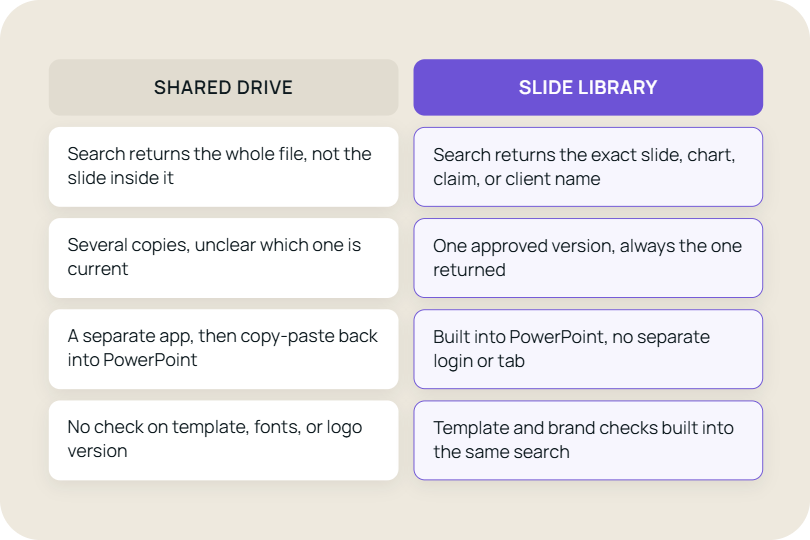
- A shared drive stores files. A slide library indexes the individual slides inside those files, so a specific project photo or safety statistic can be found in seconds instead of a folder-by-folder search.
- Proposal quality drops fastest when the team rotates, because win themes get reconstructed from memory instead of pulled from a searchable record.
It's nine at night, the RFP is due at noon tomorrow, and three people are arguing over which safety statistic belongs on the cover slide. Nobody in the room remembers the exact number from the hospital job last year, only that it worked.
This is not a one-off crunch. It is the default condition of proposal work at most general contractors, specialty contractors, and AEC firms, where the same project experience gets rebuilt every time a new RFP lands because nobody can find where it already lives.
According to MeltPlan's guide to commercial construction procurement, preparing a single RFP response typically requires 40 to 100 hours of senior staff time on a meaningful commercial project. Most of that time is not spent writing new content. It is spent finding old content and reshaping it to look new.
1. Every RFP starts with a content scavenger hunt
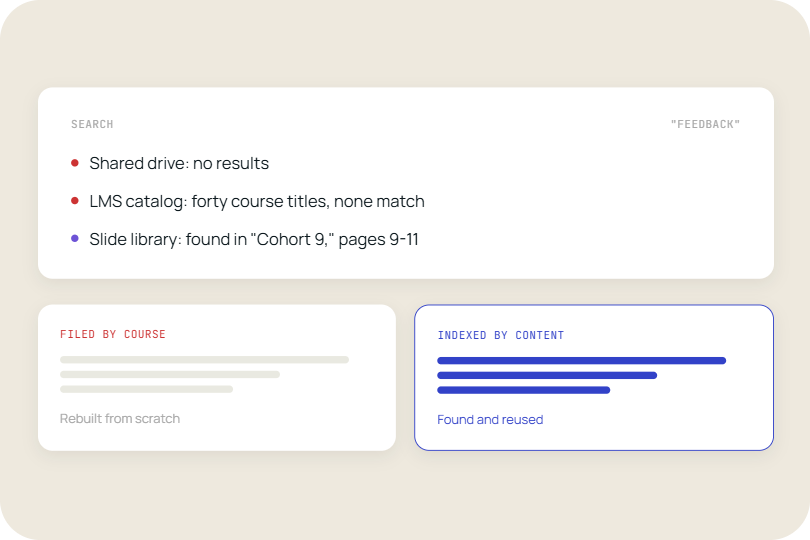
The first hours of any construction pursuit go to finding things the firm has already written, not writing anything new. A proposal coordinator pulls from estimating's shared drive for a cost table, from marketing's asset folder for photos, from a project manager's inbox for a client reference letter, and from an individual's desktop for a resume that has not been updated in two years. Each of these lives in a different system, maintained by a different person, with no shared index across any of them. When a deadline is four days out, this hunt eats the hours that should go toward sharpening the win strategy.
Firms that mature their RFP and proposal workflows see a 16 percent boost in win rates, according to ProjectMark's research on commercial construction bidding, largely because the time saved on retrieval gets reinvested in the actual argument for why the firm should win. That gap compounds. A team spending three of its four available days searching has one day left to write. A team spending one day searching has three days left to think.
This pattern repeats across firms of very different sizes. A 1,000-person specialty contractor and a 10,000-person general contractor both lose the first day of a pursuit to the same kind of search only across a different number of drives and inboxes. The scale of the firm changes how many places the content is scattered across; it does not change the underlying problem.
A slide library indexes each individual slide rather than each file, so a case study, a safety statistic, or a staff bio surfaces in a search instead of a folder-by-folder hunt. The scavenger hunt disappears because the content was never actually lost, it was just impossible to locate quickly enough to matter under deadline pressure.
2. The same case study exists in five different versions
A project completed three years ago rarely has one authoritative case study slide. It has five, scattered across five different proposals, each written by a different person, each slightly different in scope description, completion date, and photo selection. One version says the job was delivered in fourteen months, another says sixteen. Neither is deliberately wrong, but an evaluator comparing this firm's submissions across two procurements will notice the mismatch immediately.
In a shared folder, the newest file is usually assumed to be the most accurate one, but nobody actually verifies that assumption before it goes into a bid. In a slide library, a single verified version of each case study exists, and every new proposal draws from that one copy rather than whichever file someone happened to find first. This is the practical difference between managing proposal content in a shared drive and managing it in a searchable library: one relies on whoever is fastest at finding a file, the other relies on one maintained source of truth.
This is more than a cosmetic problem. Evaluation panels on public and larger private RFPs routinely score multiple submissions from repeat bidders against each other over time, and a firm that describes the same completed project three different ways across two procurement cycles reads as either careless or inconsistent, neither of which helps a bid that is already competing on trust as much as price.
The fix is not more discipline about file naming. It is removing the condition that lets five versions exist in the first place, so the newest fact about a project is also the only fact anyone can find.
3. Marketing and estimating work from different numbers
The proposal narrative and the cost estimate are often built by two teams pulling from two different data sets, on two different timelines, and evaluators notice when the numbers do not line up. An estimator finalizes a cost model at two in the morning before a deadline. Marketing already laid out a budget summary slide using a placeholder figure from the kickoff meeting three weeks earlier. Reconciling the two under time pressure produces last-minute edits that weaken the submission exactly when it needs to look most polished.
This disconnect is common enough that dedicated pursuit platforms have been built specifically to align commercial data between estimating and business development teams, so that a sales pipeline and a bidding pipeline are working from the same underlying numbers rather than two competing versions of the truth.
The people involved are not the problem here. An estimator finalizing pricing at two in the morning is doing exactly the job that role requires, and a marketing lead building slides three weeks ahead of a deadline is doing the same. The mismatch is a timing and access problem, not a competence one, and it shows up most on the pursuits the firm can least afford to lose.
When cost data and narrative content are pulled from the same verified source rather than separate silos, the figures in the slide match the figures in the estimate because they were never allowed to diverge in the first place. That alone removes one of the most common causes of a rushed, visibly patched-together submission.
4. The win strategy gets lost when the proposal team rotates
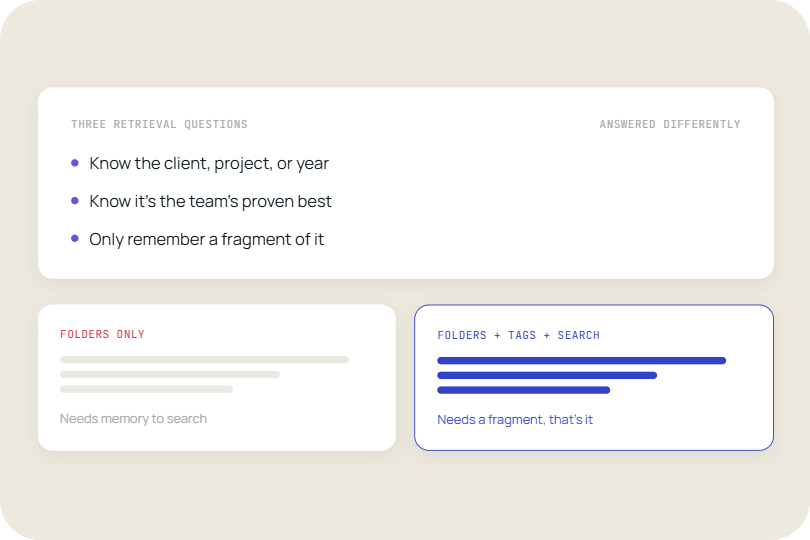
A firm's best win themes usually live in the heads of the people who wrote the last three proposals, not in a place a new hire can search. When that institutional memory is not written down and stored somewhere searchable, every staffing change resets the firm's proposal quality back toward zero.
Three situations expose this constantly:
- A newly hired marketing coordinator inherits a pursuit with four days left and no record of why a particular project photo or client quote worked in a past win.
- An estimator promoted into a business development role has to write narrative sections for the first time, with no example of what a strong version looks like.
- An outside consultant brought in for a single high-stakes pursuit has to reconstruct the firm's differentiators from scratch because nothing is centrally documented.
In each case, the firm is not short on good material. It is short on a way to find the good material that already exists. Every departure takes a slice of institutional memory with it, and every arrival has to rebuild that same slice from scratch before contributing at full strength.
Storing win themes as searchable slides rather than as knowledge held by specific employees means a rotating team does not have to relearn what already works. The firm's best material stops being tied to whoever happened to write it, and starts being available to whoever needs it next.
The structural shift underneath all of this
The deeper issue is not any single missing folder or outdated resume. Construction proposal work has scaled past what shared drives and inboxes were ever built to hold, while procurement timelines keep compressing rather than expanding.
Firms that win consistently have stopped treating past proposals as archives to be filed away and started treating them as a body of institutional knowledge to be searched. That is a shift in what a proposal actually is, from a finished document to a set of reusable, individually findable pieces. It is also a shift in who can contribute meaningfully to a pursuit, since the material stops depending on tenure and starts depending on access.
When the transition becomes necessary
A few signs reliably indicate a firm has outgrown its current proposal process:
- The same case study slide gets rebuilt for more than two pursuits in a single quarter.
- Deadline weeks regularly require weekend work just to reconcile mismatched numbers between estimating and marketing.
- A new marketing hire takes more than a month to find out where existing content actually lives.
- Win themes visibly vary in quality depending on which staff member happens to assemble the pursuit.
- Senior staff spend more hours locating past content than writing anything new for the current one.
- More than one version of a flagship project's case study is circulating across the firm at the same time.
Every quarter this continues, the firm pays for the same slide twice: once in its original creation, and again in every rebuild that follows.
What this actually costs a proposal team
None of this comes down to effort. Construction proposal teams already work long hours under real deadline pressure, and the people involved are not careless. The problem is structural: content that should be reusable is stored in a way that makes it effectively unfindable, so the same work gets repeated every time a new RFP arrives.
Firms that fix this are not spending more on marketing. They are recovering hours that were already being spent, and redirecting them from searching to strategy. For a firm submitting a dozen or more RFPs a year, that redirected time shows up directly in win rate and in how many pursuits a lean team can realistically take on without burning out its best people.
TeamSlide is built for exactly this problem. It sits directly inside PowerPoint, turning your firm's case studies, resumes, safety records, and past win themes into a searchable, slide-level library that your next RFP response can pull from instead of rebuilding from scratch. If your content already lives in SharePoint, OneDrive, or wherever your firm keeps its project files, there is no need to move it. TeamSlide connects directly, so every past pursuit becomes instantly searchable from day one.
Related reading:
How can marketing teams enforce brand compliance in presentations without slowing sales?
Why SharePoint Alone Is Not Enough for Enterprise Slide Management
Frequently asked questions
Why do construction companies keep rebuilding the same proposal slides? Most construction firms store project photos, case studies, resumes, and safety records across shared drives, email inboxes, and individual desktops rather than in one searchable place. When a new RFP lands, nobody can locate the exact slide that already exists, so the proposal team rebuilds it from memory or from an old screenshot. The content was not missing, it was just scattered across systems with no shared index. A slide library solves this by making individual slides, not just files, searchable across the whole firm.
How long does it take to respond to a construction RFP? Preparing a single commercial construction RFP response typically requires 40 to 100 hours of senior staff time, according to MeltPlan's procurement guide, with larger or design-build projects taking longer. Much of that time goes toward locating and reformatting content that already exists from past pursuits rather than creating anything new. Firms with a searchable content library spend a smaller share of that time on retrieval, which frees senior staff to spend more time on the strategy and pricing decisions that actually influence whether the firm wins.
What is the difference between a slide library and a shared folder? A shared folder stores whole files, such as PowerPoint decks or PDFs, and finding a specific slide inside one means opening files one at a time and scanning them manually. A slide library indexes individual slides directly, so a search for a specific project, statistic, or staff bio returns the exact slide rather than a list of files that might contain it. This matters most under deadline pressure, when a proposal team does not have time to open a dozen old decks to find one usable slide.
Do construction firms still need proposal writers and marketing staff if they use AI tools? Yes. AI tools and slide libraries speed up retrieval and formatting, but they do not replace the judgment needed to choose a win strategy, interpret an owner's evaluation criteria, or write a persuasive narrative around a project's specific challenges. The value of proposal and marketing staff shifts from manually hunting for content toward shaping the strategy and story once the right material is easy to find. Firms that treat this as a replacement for their team rather than a support for it tend to see proposal quality decline, not improve.
How does inconsistent proposal content affect a construction firm's win rate? When the same completed project is described with different dates, scopes, or figures across multiple submissions, evaluators reviewing more than one proposal from the same firm notice the inconsistency and it damages credibility. ProjectMark's research on commercial construction bidding found that firms with more mature RFP and proposal workflows see a 16 percent boost in win rates, largely because their submissions read as cohesive rather than assembled under last-minute pressure. Consistency across submissions signals that a firm is well organized, which is itself part of what owners evaluate when comparing contractor capability.
Can TeamSlide connect to SharePoint or OneDrive for construction proposal content? Yes. TeamSlide connects directly to storage systems such as SharePoint and OneDrive, so a firm's existing project photos, case studies, and templates do not need to be moved or reorganized before they become searchable. TeamSlide works inside PowerPoint itself, indexing individual slides from a firm's existing library so proposal teams can search and reuse content without changing where files are stored or how the team already works day to day.



More from our blog
Discover insights and strategies for better presentations