What Is Content Debt? The Hidden Cost of a Repository You Can't Search
Ask an operations lead what's wrong with how their firm stores decks and most will describe volume: too many decks, too many versions, not enough hours to sort through them. That is a symptom. The actual mechanism has a name borrowed from a different industry entirely.
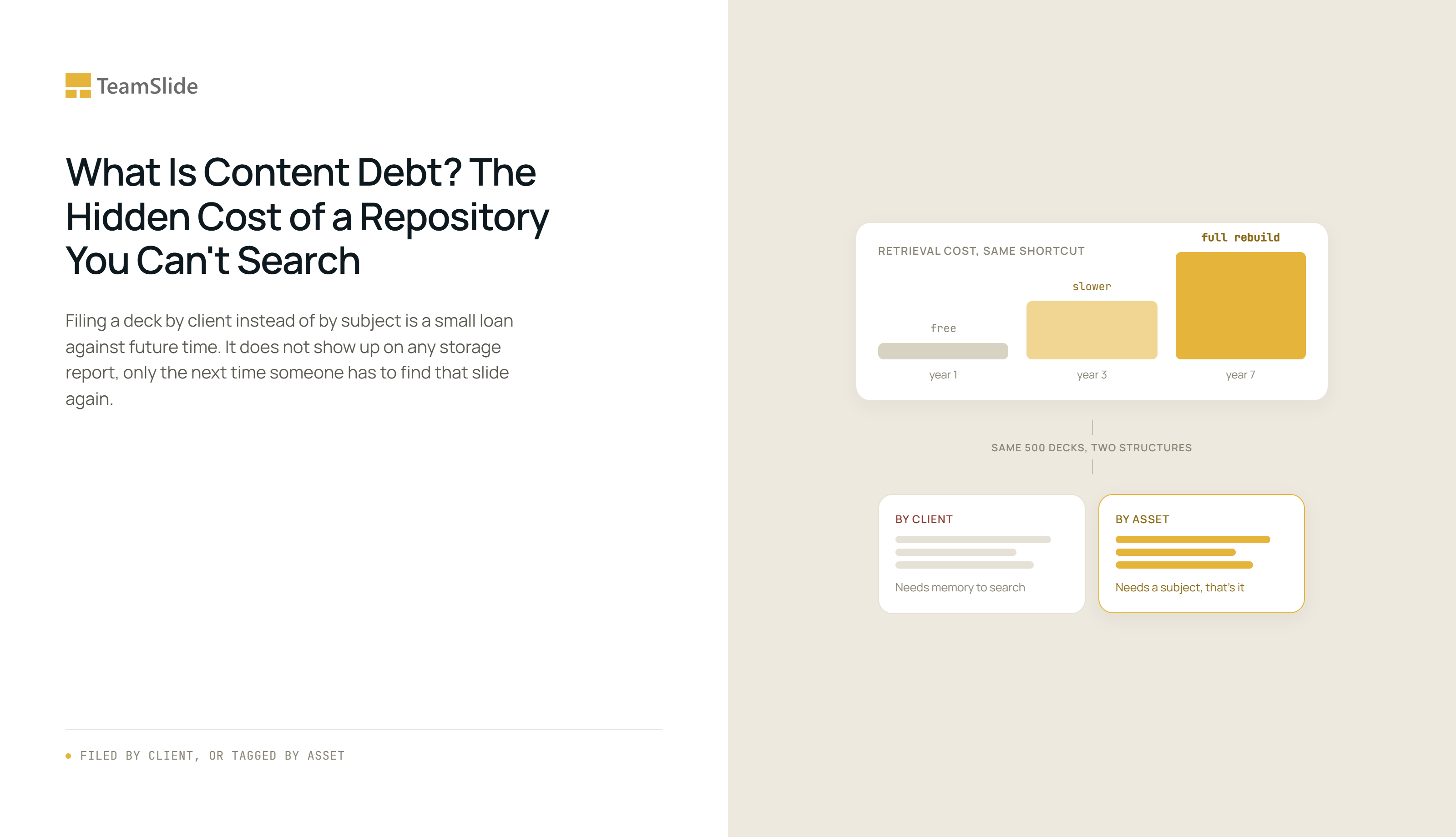
Software engineers call it technical debt: the deferred cost of a shortcut taken to hit a deadline, paid back later with interest. Its origin traces to Ward Cunningham in the early 1990s, who used the metaphor of financial debt to describe what happens when a team ships something workable now instead of something well-structured, knowing the difference will have to be settled eventually. Professional-services firms run the identical arithmetic on their content. Every deck, proposal, or case study assembled under deadline pressure and filed away by client name instead of by subject is a small loan against future time. The debt does not show up on any storage report. It shows up the next time someone has to find that slide again.
Debt accrues at the point of filing, not the point of creation
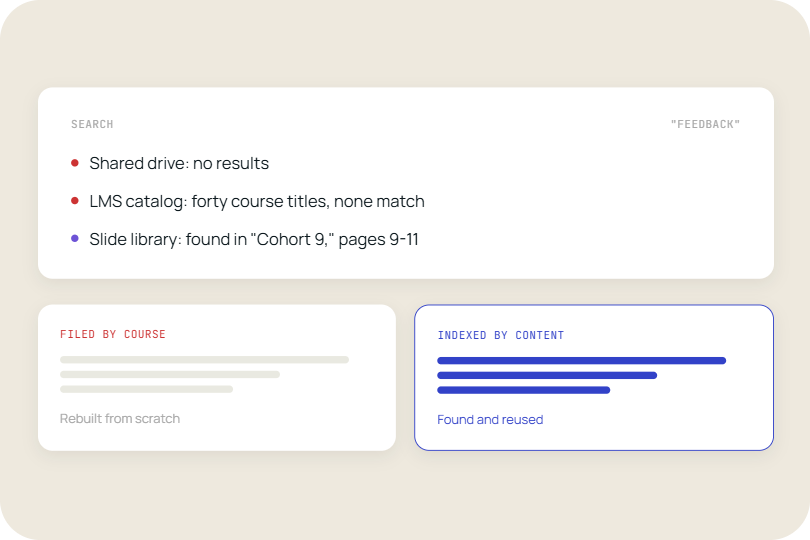
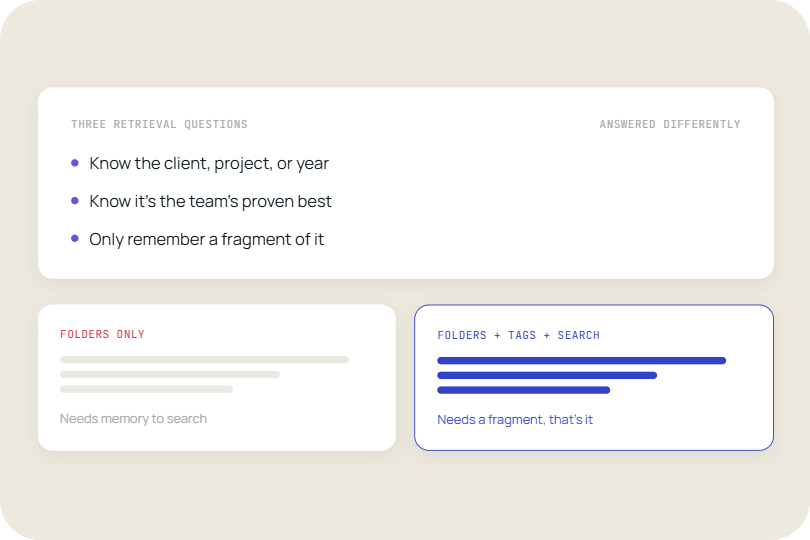
A deck built for one client is not, by itself, a liability. It becomes one the moment it is saved somewhere that only makes sense in hindsight, a folder named for the client rather than for the indication, the industry, or the argument the deck actually makes. The first time someone needs that content again, they need to already know which client it was for. That is the entire cost model of content debt: retrieval that depends on memory instead of metadata.
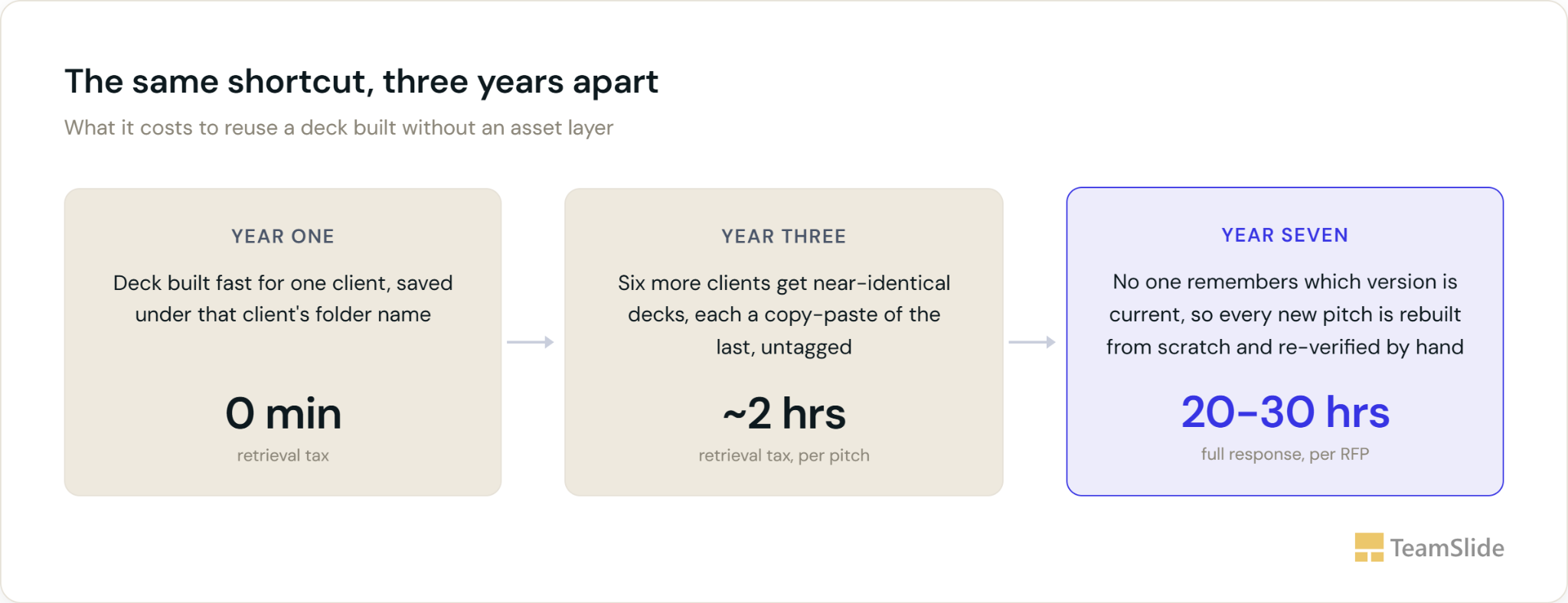
That escalation is not exaggerated. Industry benchmarking puts the average RFP response time at roughly 25 hours per proposal. Teams with an active content library reuse about 66% of their content across proposals, while teams without one spend 40% more time writing from scratch. Content reuse is therefore one of the biggest drivers of response efficiency.
Three industries running the same bill under different names
Contract research organizations know it as the bid defense: a sponsor's evaluation team asking a CRO to walk through exactly how it will run a specific protocol, not recite generic capability slides. Guidance on these meetings consistently notes that sponsors steer the conversation toward the study at hand precisely because a canned answer is easy to spot. The irony is that the fastest way to sound tailored is to draw the protocol-specific detail from a library organized by indication and phase, not to write it fresh every time a new sponsor calls.
Law firms carry the same debt under the heading of knowledge management. A junior associate preparing a pitch or brief may have to search across practice-group resources, shared drives, and past matters to find the right version of a clause or case example. The problem is rarely that the good version was deleted; it is that the right version is difficult to find.
Financial services teams meet it in the RFP itself. Compliance requirements and multi-stakeholder review push enterprise response effort well past 30 hours per proposal, and a large share of that time is not analysis, it is re-locating and re-verifying language the firm has already written and had approved before, sometimes for the same prospect twelve months earlier.
Better access to existing content is what pays the debt down
None of these industries have a content shortage. Pharma sponsors, law firms, and financial services teams all sit on years of approved, client-tested material, most of it already living in SharePoint, Box, OneDrive, or some combination of the three, organized the way it was always organized: by client, by matter, by deal. That structure isn't wrong, it's just answering a different question than the one someone asks when they're staring at a blank deck.
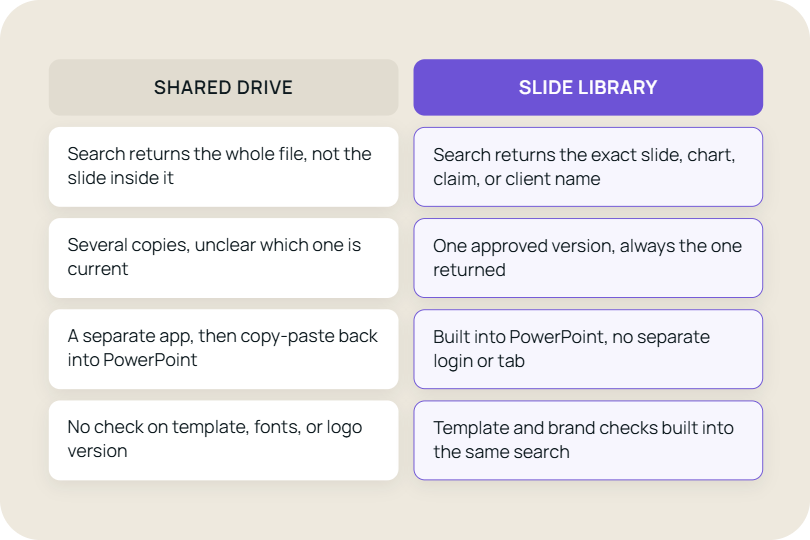
A slide library connects to those systems as they already exist, no migration, no folder cleanup, and changes what a search actually returns. Instead of opening a client folder and scanning ten decks by eye, someone types "oncology" and gets a slide-level result: a thumbnail of every oncology slide across every client and every year, pulled from the text on the slide itself rather than from a tag someone had to apply first. Wherever a firm already tracks metadata, an indication or practice-area column in SharePoint, say, that comes through automatically and narrows the results further. Click the thumbnail and it drops straight into the deck already open in PowerPoint. Nothing about the SharePoint or Box structure changes; what changes is that finding the one oncology slide from three years ago stops requiring anyone to remember which client it was built for.
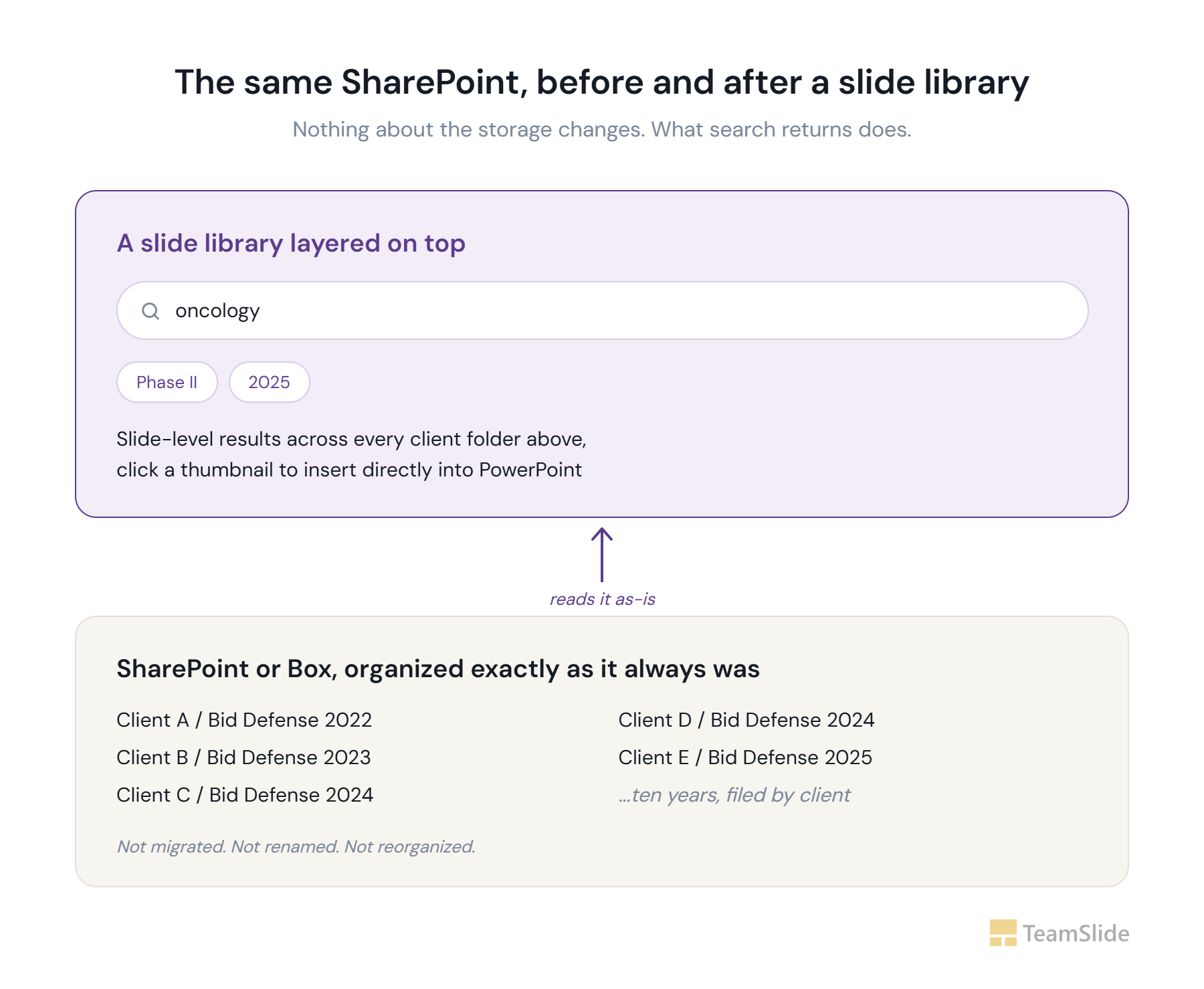
The folder structure still asks the searcher to already hold the answer in their head: which client, which year, which of three or four decks. A slide library layered on top asks a different, much easier question: what is this slide about. That second question scales because it does not depend on any one person's memory of a decade of engagements.
A pile of decks that only works for the person who built it isn't a library. It's a memory with a search box bolted on.
Three Questions that reveal whether Debt is compounding
1. Can a new hire find last quarter's best slide on a topic without asking a colleague where it lives?
2. When two people pull the same clause or chart, do they get the same version?
3. Does finding a past example take less time than rebuilding it from scratch would?
A no on any of the three is not a filing problem. It is interest coming due, and it will keep coming due on every deck, brief, and proposal until the library is organized around what the content is, not around who it was first built for.
FAQs
What is content debt?
Content debt is the accumulated cost of reusable material, decks, clauses, and case studies that become difficult to find, verify, or reuse because they lack the structure, metadata, and version control needed to manage them over time.
How is content debt different from just having too many files?
Volume alone is not debt; a well-tagged library of 50,000 slides retrieves faster than a poorly organized repository of 500. Content debt is specifically about the retrieval structure, whether content is filed by project (which only helps someone who already knows the project) or by subject and type (which helps anyone searching by topic).
Why do bid defenses and RFP responses take so long even with years of past decks already on file?
Because most libraries are organized by client or matter rather than by subject, so the response team has to first guess which past engagement resembles the current one before they can even start searching. Industry benchmarking puts average RFP response time at roughly 25 hours, rising to 30 to 50 hours in regulated sectors where compliance review adds another layer on top of the search itself.
What is content reuse rate and why does it matter?
Content reuse rate is the share of a proposal or deck built from pre-approved existing material rather than written from scratch. Teams below 50 percent are effectively starting over each time; teams above 70 percent are drawing down a library, which is both faster and more consistent.
Does adding a slide library mean migrating everything to a new system?
No. The fix is usually a metadata and search layer added on top of an existing system like SharePoint, not a wholesale migration. Tagging content by subject, phase, or type while leaving the underlying files where they are is what turns a folder structure into a searchable asset library.
Who should own fixing content debt inside a firm?
It doesn't require anyone to own it in the way technical debt needs an engineering owner, and it shouldn't be framed that way, because it isn't about spending months fixing the folder structure in SharePoint. That reorganization gets proposed at most firms and basically never happens. What actually helps is that a slide library indexes the text on every slide directly, so search works on day one without anyone tagging or renaming a thing in SharePoint first, and it pulls in whatever metadata already exists there rather than asking someone to recreate it. Someone still glances at an occasional stale-slide flag or pins a handful of best assets, but that's a few minutes a week, not a restructuring project.
Can AI slide generation replace a properly organized content library?
No, it depends on one. A slide generator still needs to draw from approved, correctly tagged source material to produce something accurate and on-brand; without an organized library underneath it, generation just produces a faster way to write the wrong thing.
Turn the next rebuild into a search instead
TeamSlide indexes a firm's existing decks at the slide level so a slide created three years ago for another client can surface when its subject matches what you're working on, not just when you remember its filename. Instead of rebuilding proven content from scratch, teams can find and reuse the right slide when they need it.



More from our blog
Discover insights and strategies for better presentations