Due Diligence Questionnaires (DDQs): How Investment Managers Can Find Answers Faster
A compliance officer at a boutique manager is reconciling two decks sitting in the same prospect's inbox. One shows the flagship strategy's five-year net return at 11.2 percent. The other, built for a different allocator eight weeks earlier, shows 11.6 percent. Neither number was made up. They came from two different performance runs, pulled at two different points in the quarter. Nobody noticed both decks were still live in the field at the same time.
Nobody necessarily did anything wrong. The deck was built with the right number at the time, and then it kept circulating after a newer figure was available. At first glance, it looks more like a filing problem than a compliance problem.The underlying problem is fairly common at boutique managers: the questions allocators ask are often standardized, but the way firms store the answers usually isn't.
Most allocators are asking some version of the same questions
Institutional due diligence is rarely an entirely new conversation. On the private markets side, the Institutional Limited Partners Association's DDQ provides a standardized framework for investors evaluating private equity and other private-market managers, covering 20 areas of diligence spanning firm governance, investment strategy, risk, operations, ESG, and fund economics. On the hedge fund and alternatives side, the AIMA Illustrative Questionnaire plays a similar role, providing an industry-standard framework for due diligence of investment managers.
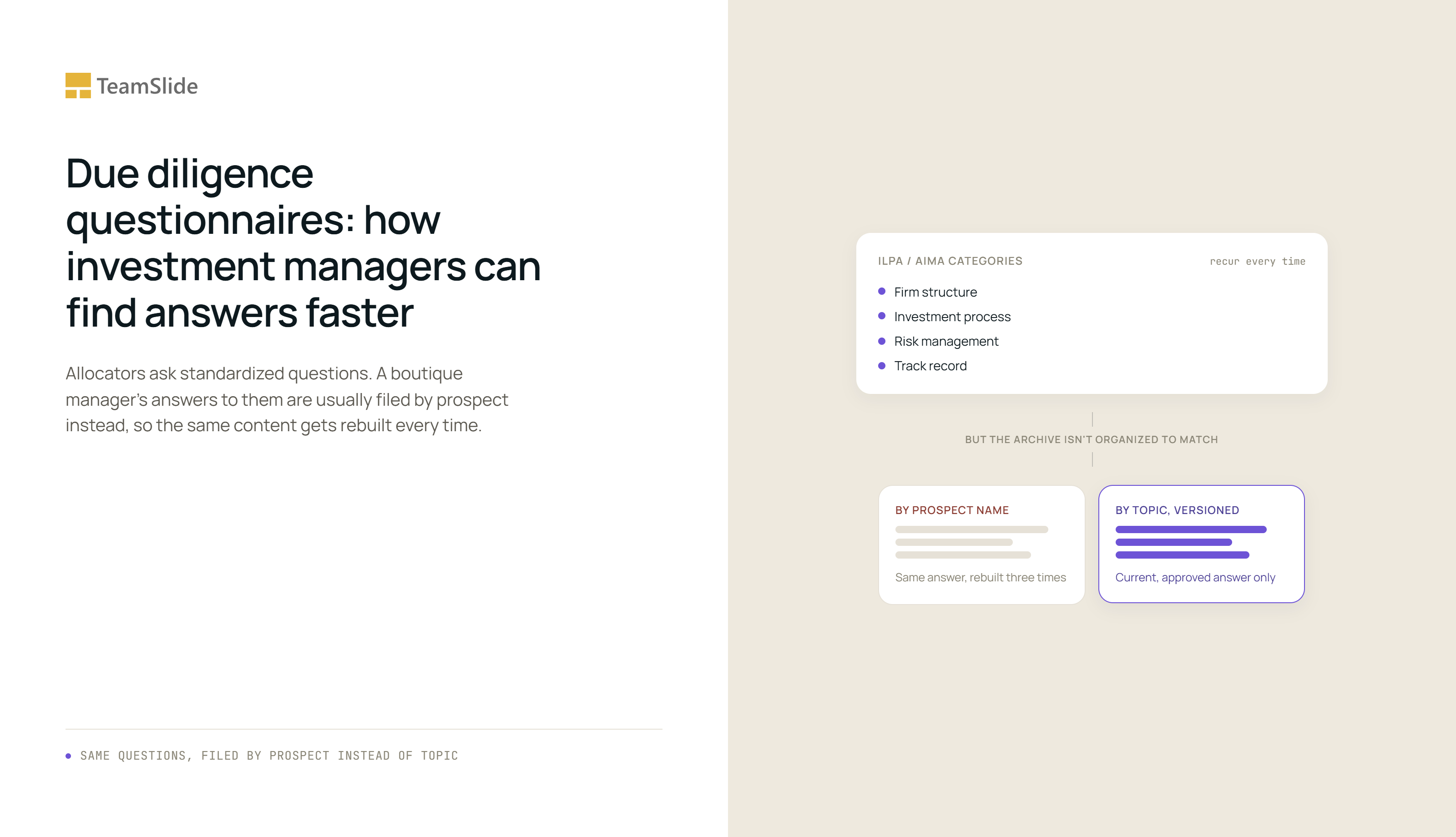
The idea behind standardization was to make the process easier for both sides. An allocator's operations team can compare managers against one consistent framework instead of parsing a different questionnaire format from every firm. In practice, it also means the same six or seven categories of question, firm structure, investment process, risk management, track record, operations and compliance, ESG, recur almost verbatim from one DDQ to the next.
The answers are organized around the wrong axis
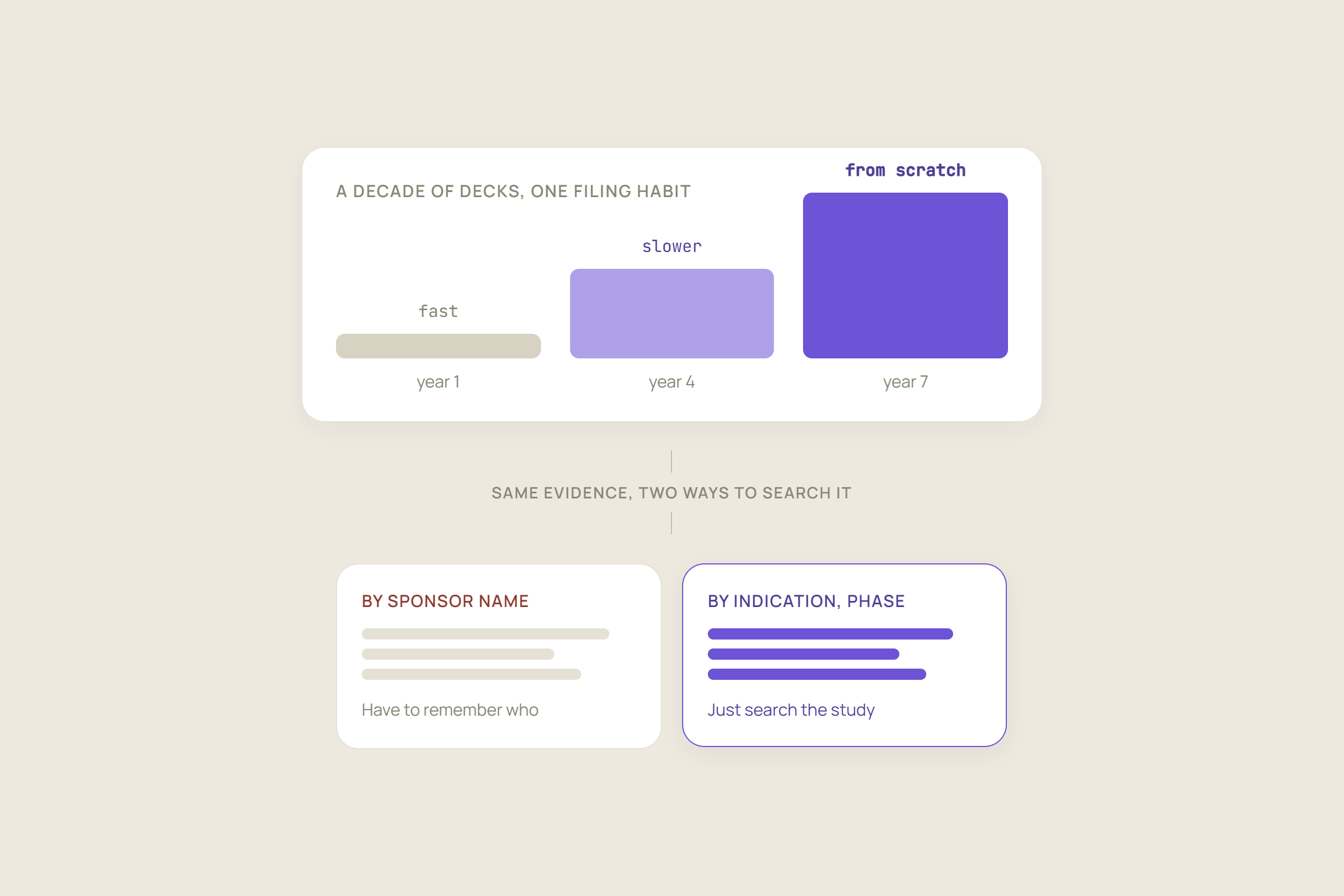
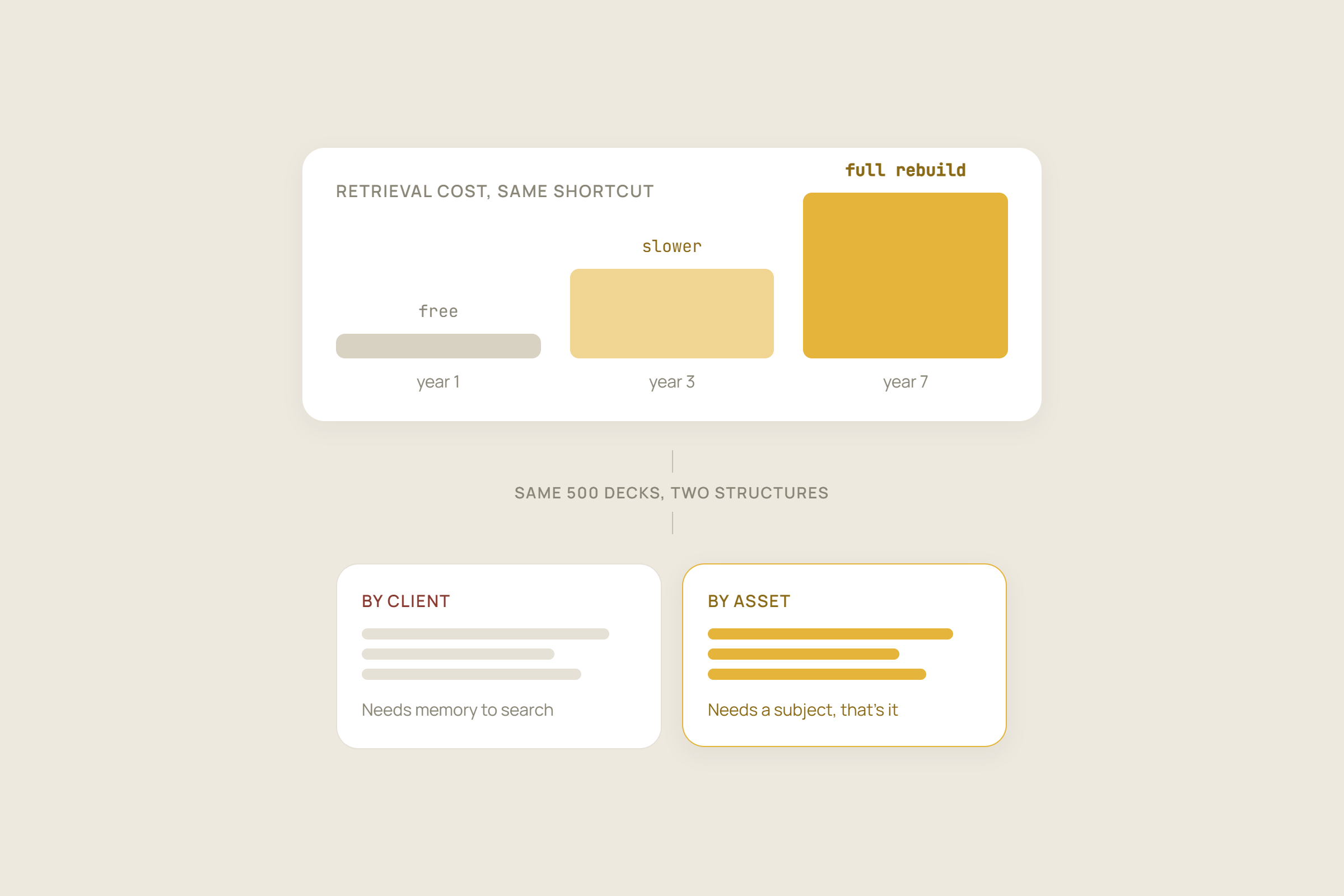
If the same questions keep coming up, you would expect the answers to get easier to produce over time. For most boutique managers, that isn't what happens. The content is usually filed around the client or prospect rather than around the question it answers.
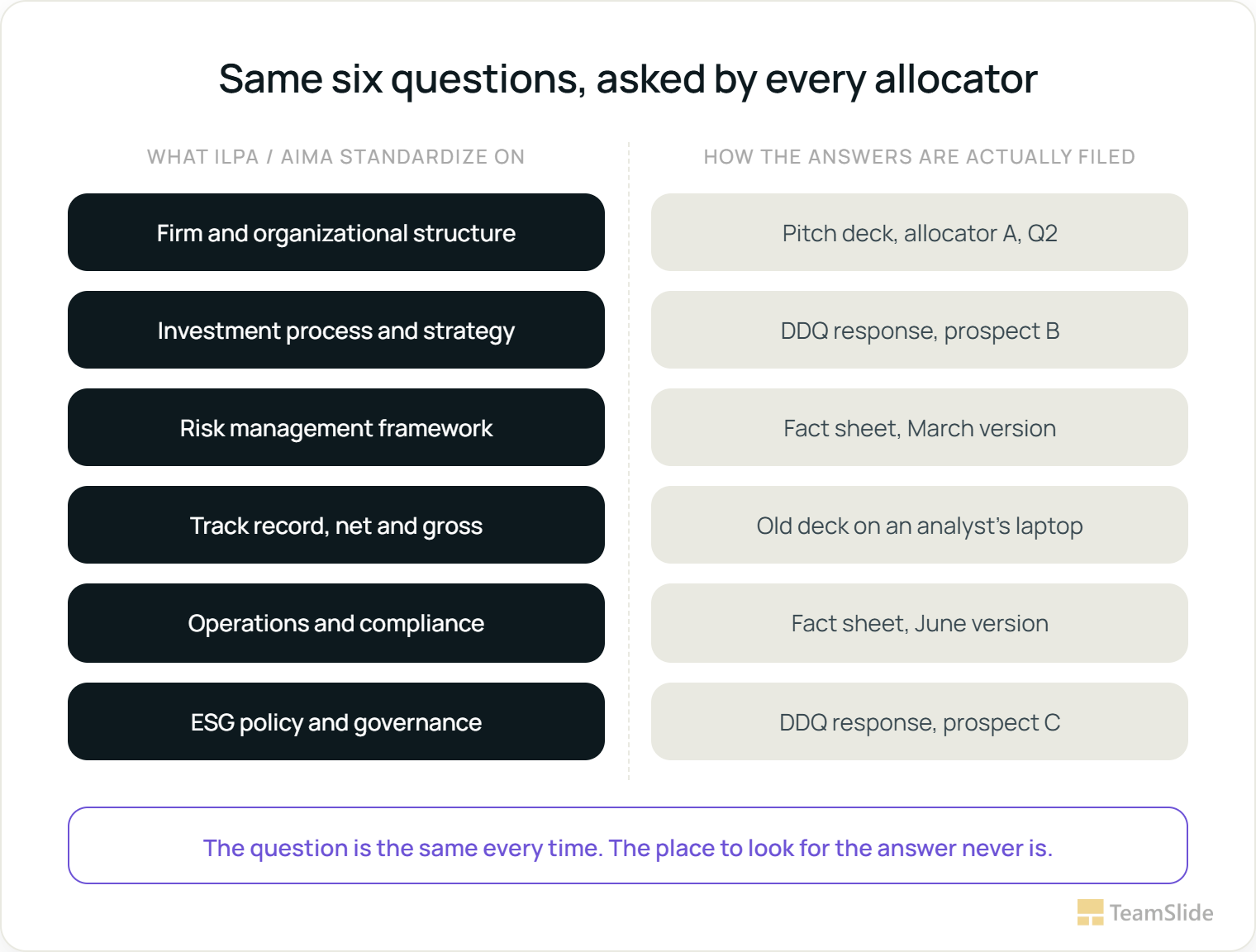
A risk management slide gets written for Allocator A in March. A fact sheet gets refreshed for a consultant in June. Then, in August, someone rebuilds a track record table from a spreadsheet because nobody remembers that a cleaner version already exists in Allocator A's folder. The work had effectively been done three times, but none of the people doing it could easily see what had already been created.
This is the same kind of problem we've written about in other regulated, standardized-question industries, most directly in the piece on CRO bid defense, where sponsors ask a similarly structured set of questions and a CRO's best past answers are just as likely to be buried under a client's name instead of the topic they actually address. It is really a specific case of what happens whenever content gets organized by who it was written for instead of what it actually contains, a pattern that compounds quietly until someone finally has to search for something specific under deadline pressure.
An outdated number can become a compliance problem
In construction or professional services, an outdated stat on an old proposal is embarrassing if someone notices. In investment management, it can be a regulatory problem. Under the SEC's Marketing Rule, advisers generally cannot present gross performance in an advertisement without also presenting net performance with at least equal prominence, calculated over the same period and using the same type of return and methodology. For advertisements other than those including private fund performance information, the rule also establishes one-, five-, and ten-year presentation requirements.
The rule is not limited to a firm's website or traditional advertising copy. Where an investor-facing communication qualifies as an advertisement under the rule, its performance presentation is subject to the applicable requirements. An investor-facing pitch deck may therefore fall within the rule's scope depending on how and to whom it is distributed. Advisers are also subject to recordkeeping requirements covering advertisements and certain records supporting performance information, so an old inconsistency does not simply age out of relevance.
An outdated figure can still create a problem even if it was originally correct. That is why keeping track of which version is current matters.
It also costs a lot of hours
The time involved can add up quickly. One operations team managing institutional private market allocations processes more than 200 DDQs a year at roughly 40 person-hours each, which works out to about 8,000 hours annually, the equivalent of four full-time employees whose entire job is questionnaire logistics. Even at a smaller boutique manager, that work can pull senior investment and IR people away from client work. Even a standard, shorter DDQ is no small task: a typical 100-question institutional questionnaire takes an average of four to five hours just for a first draft, before any customization for a specific allocator's focus areas.
The burden compounds because a DDQ is not a single hurdle a fund clears once. Unlike an RFP, which typically happens once at the start of a relationship, a due diligence questionnaire recurs across the life of the investment, as an ongoing risk-assessment tool an allocator returns to on a schedule, not just at the pitch.
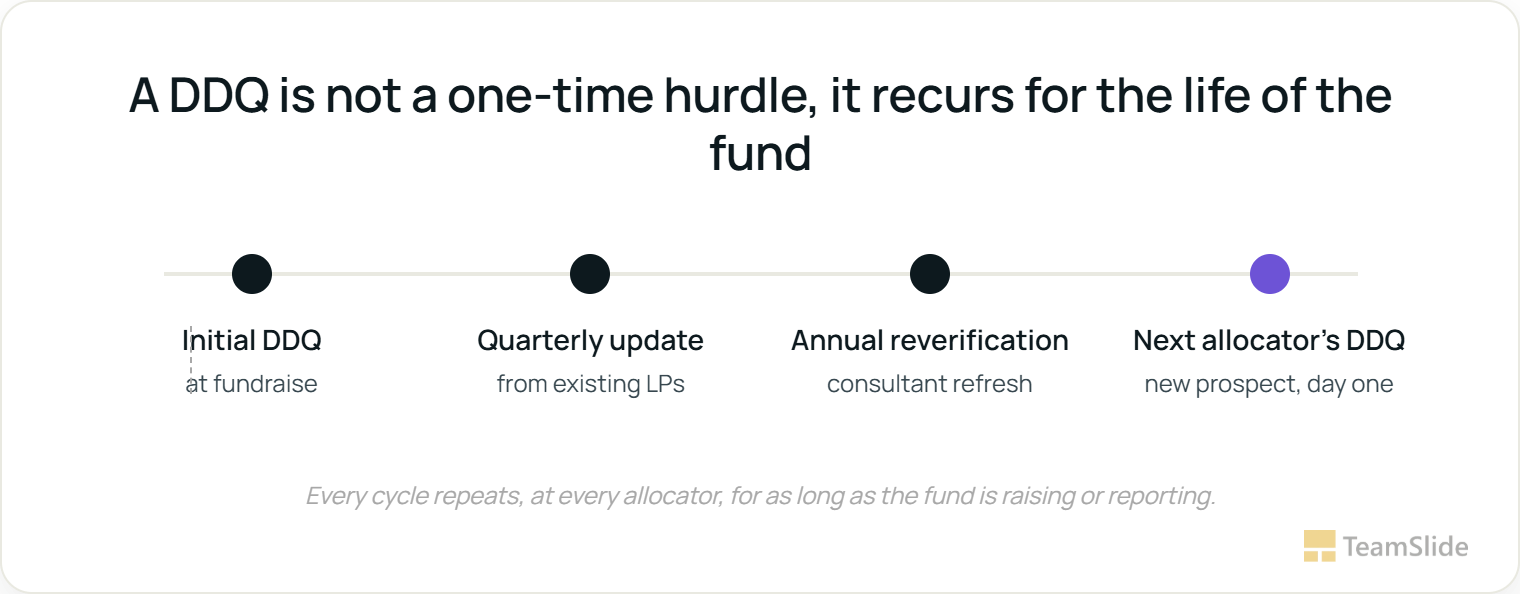
You see the problem most clearly in a few common situations. A new IR hire inherits a live DDQ with four days on the clock and no record of why a particular risk narrative worked with the last allocator. An analyst promoted into an investor-facing role has to write ESG and operations answers for the first time with no example of what a strong version looks like. An outside consultant brought in for a single high-stakes raise has to reconstruct the firm's differentiators from scratch because nothing is centrally documented.In each case, the firm probably already has most of what it needs. The problem is finding it quickly enough when there are only a few days to respond.
A shared drive is useful, but it does not solve the retrieval problem
Most managers already sense this and have taken a first step toward fixing it. Proposal and operations teams commonly maintain a central repository of approved responses that gets reused and updated as new questionnaires arrive, which is the right instinct. The problem is what that repository usually is in practice: a shared drive of Word documents and old decks, organized by folder and filename, the same organizing logic that created the mismatch in the first place. Finding the right paragraph still means opening files one at a time and reading until something matches, which is a faster version of the original problem, not a different one.
The fix is not another place to store files. SharePoint, Drive, or a shared network folder already does that job adequately. What is missing is retrieval at the level of an individual answer or slide, so a search for the current, board-approved version of the risk management narrative returns exactly that slide, not a list of twelve decks that might contain something close to it.
What changes when retrieval works at the slide level
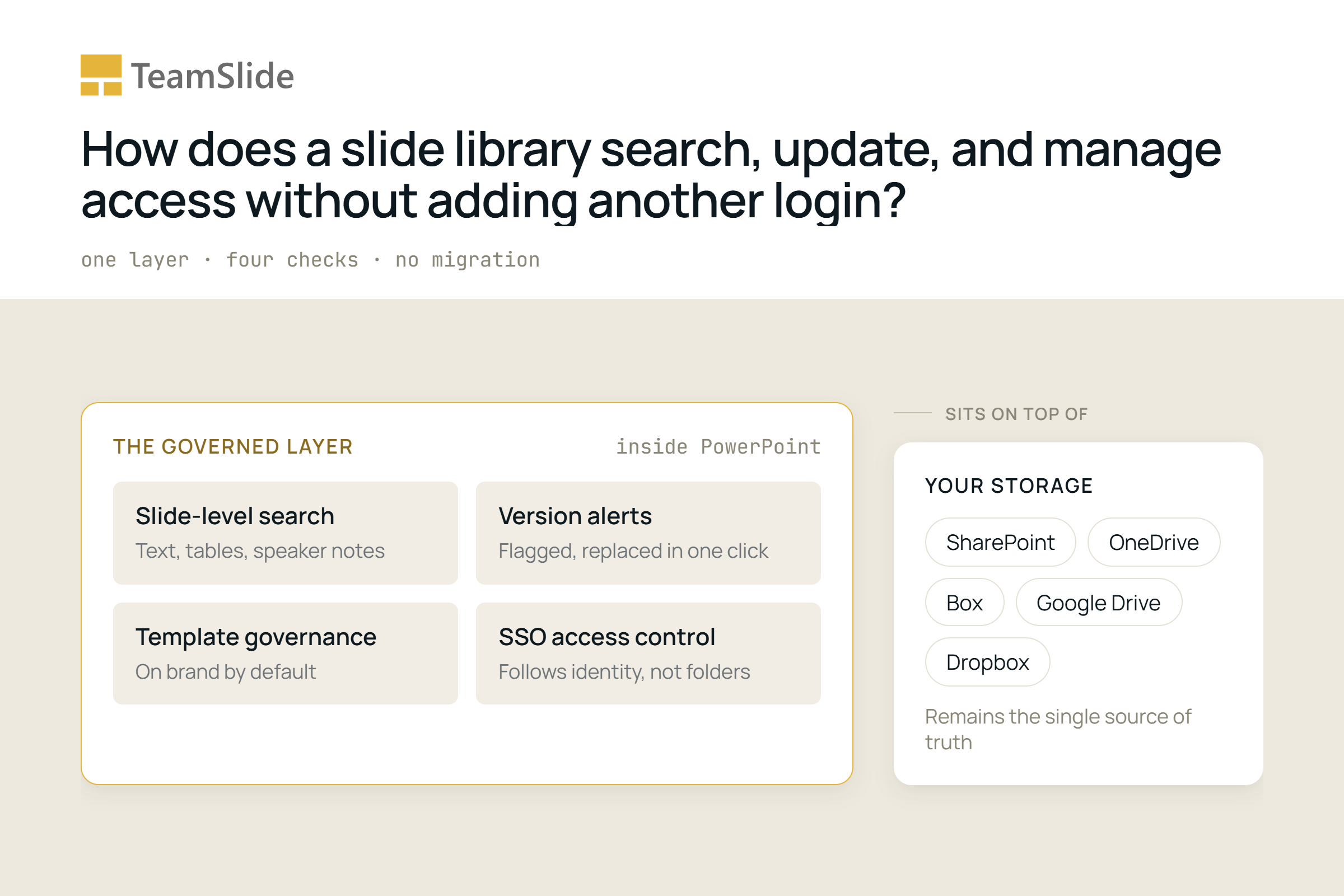
This is where a searchable slide library can help. TeamSlide indexes a firm's existing decks and DDQ responses at the individual slide level, connecting directly to content already sitting in SharePoint or a shared drive rather than asking a team to migrate anywhere. A track record slide, a risk framework answer, an ESG policy summary each become independently searchable, so the latest approved version is easier to find and reuse in the next DDQ, rather than relying on whichever file someone happens to open first.
That matters most for the performance and compliance content covered above. A version-controlled library flags a slide once the figure it carries has gone stale, instead of leaving five copies of the same track record circulating with five different numbers. The same discipline that keeps a construction firm's safety statistics current applies here with sharper stakes. A defensible, consistent record matters more than a tidy-looking deck.
None of this replaces the judgment an experienced IR team brings to a raise. Choosing which risk narrative to lead with, reading what a specific allocator actually cares about, deciding how much of the ESG section deserves emphasis, that is still a human call. The goal is simply to spend less time hunting for the old answer and more time adapting it to the allocator in front of you.
For teams weighing where a searchable library fits into a finance or investor-relations workflow specifically, TeamSlide's finance and investment solutions overview covers the broader case beyond DDQ response, including quarterly reporting and board materials that carry the same staleness risk.
Make the next DDQ easier to answer
TeamSlide indexes a firm's existing pitch decks, fact sheets, and other PowerPoint content at the slide level, so the latest approved version of a risk framework, track record, or team bio is easier to find and reuse when a new allocator asks. It connects directly to SharePoint and other supported repositories, so nothing has to move before it becomes searchable.
→ Schedule a demo
Frequently Asked Questions
How is a due diligence questionnaire different from an RFP for a fund manager?
An RFP is generally part of the initial selection process, while a DDQ is used to assess and monitor a manager's operations, strategy, risk, and other areas of diligence. DDQs can come up repeatedly throughout the relationship.
Does this replace the ILPA or AIMA questionnaire templates?
No. ILPA and AIMA define what allocators ask; a slide library organizes and retrieves a manager's own verified answers to those standardized questions. The templates define the questions. The library helps the manager keep its own answers organized, current, and easy to retrieve.
Can a slide library help with SEC Marketing Rule compliance?
A version-controlled library can reduce the risk of an outdated or inconsistent performance figure remaining in circulation by helping teams identify older slide versions when a newer approved version exists. It does not replace a firm's compliance review process or legal judgment.
What happens to a due diligence response when a key team member leaves?
If the best answers are scattered across one person's decks, folders, or memory, a new team member has to piece them together again. A searchable library gives them a better starting point and makes it easier for someone new to reuse answers that have already been reviewed and approved.
How much time does a typical DDQ actually take to prepare?
A standard 100-question institutional DDQ takes roughly four to five hours for a first draft before any customization, and larger operations teams handling high DDQ volumes report totals in the thousands of hours annually. A significant portion of that work can involve locating, reviewing, and adapting existing content rather than writing every answer from scratch.
Does TeamSlide require migrating existing DDQ content to a new system?
No. TeamSlide connects directly to a firm's existing SharePoint and other supported repositories and indexes PowerPoint content at the slide level, so past decks and presentation-based DDQ material can become searchable without being moved or restructured first.



More from our blog
Discover insights and strategies for better presentations