
Two hours before a client call, a consultant opens an empty deck and types a prompt into an AI slide tool. What comes back looks reasonable: clean layout, sensible bullets, a chart where a chart belongs. It just does not look like her firm’s deck. The title hierarchy is slightly off, the color does not signal emphasis the way the brand does, and the whole thing reads as something a generic tool produced, because it is.
That gap is turning up across consulting, advisory, and enterprise sales teams,and it is not simply a prompting problem. It is the predictable result of how AI slide generation has changed over the past year.
The short version
- Until early this year, AI slide generation mostly meant filling in a pre-approved template. Output was brand-safe, but capped at whatever someone had built in advance.
- The 2026 model updates unlocked generation from a blank canvas. The range ceiling disappeared, and a new problem appeared: output that looks competent but generic.
- Consulting teams feel this most. They already lose fifteen-plus hours a week to deliverables, and an off-brand slide in front of a client is a commercial risk, not just an aesthetic one.
- Brand consistency is a revenue lever, tied to double-digit gains in independent research, and it applies to a pitch deck as much as to a marketing campaign.
- The fix is an explicit, machine-readable design system: typography, spacing, chart treatment, and visual vocabulary defined precisely enough to hold across unlimited content.
For years, much of AI slide generation meant filling in a template
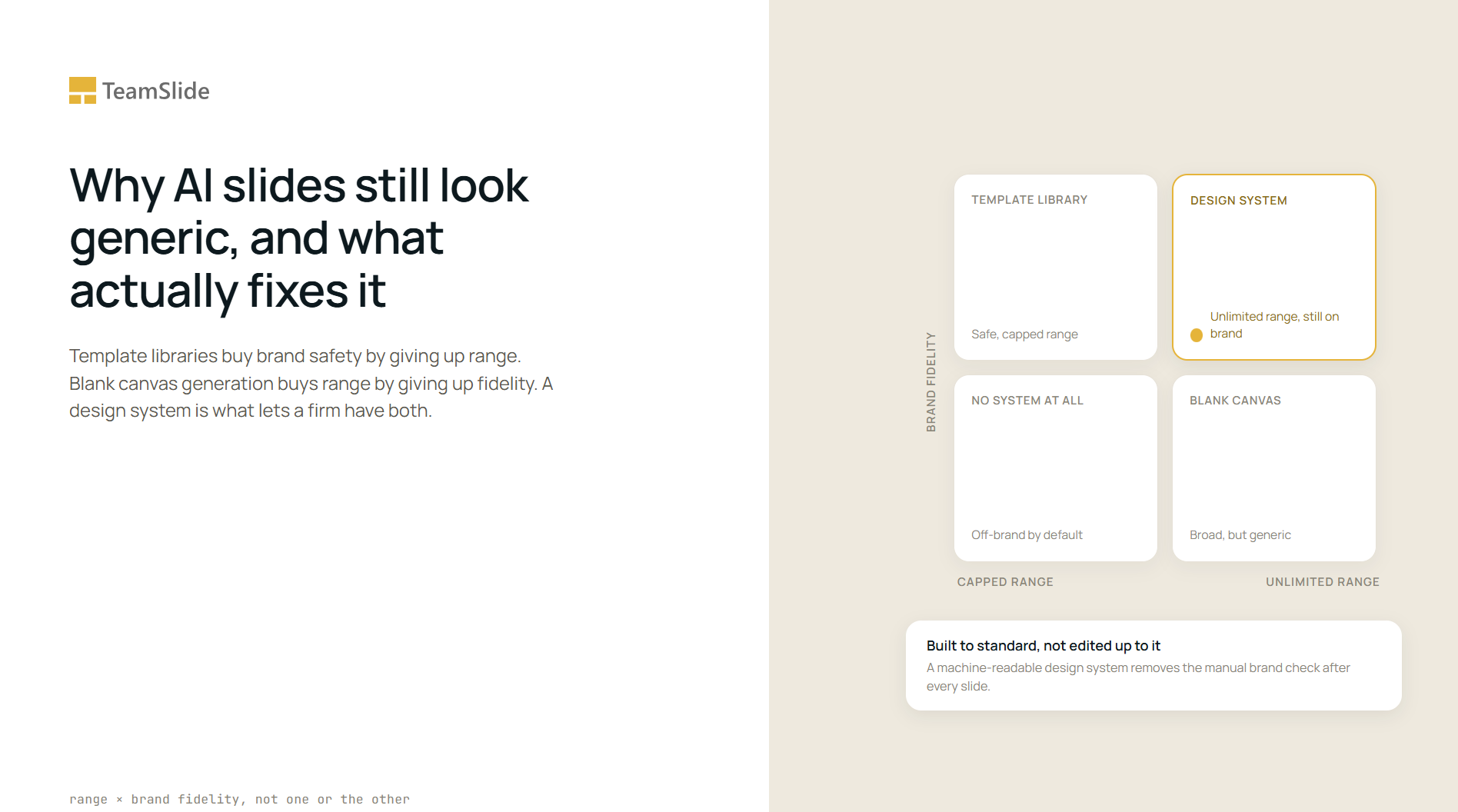
For most of the time these tools have existed, generating a slide meant matching content to a fixed library of layouts. A system held a set of pre-built templates, a model picked the closest fit, and the content dropped into place. It is fast, and it is brand-safe by construction: every template in the library was approved before anyone generated anything.
The cost is range. Output is capped at the templates someone built in advance, and a request that does not fit an existing shape has nowhere to go. Enterprises accepted that trade deliberately, because a static template cannot drift off-brand. It also cannot adapt. Build enough decks from the same finite set of containers and they start to look interchangeable.
Early 2026 made blank-canvas generation practical and exposed a different problem
The model updates earlier this year changed the starting point. A system could now design a slide from scratch: no library, no predetermined layout, just the content and a structure reasoned to fit it. That is the capability Slidebuilder by TeamSlide is built on, and it is a genuine shift.
But the first wave of from-scratch output had a recognizable flaw. It read as competent and generic at once: fine for an internal status update, wrong for a strategy presentation that has to carry a brand in front of a client, an investment committee, or a board. The issue is not simply model quality. “Generate a good-looking slide” and “generate a slide that is unmistakably this firm’s” are different tasks, and only the second needs brand-specific information. In Brafton’s 2026 survey of marketers using AI, the most common quality complaint, chosen by 87 of 132 respondents, was that the output sounded thin or generic. Given no design system to apply, a model falls back on its own learned average, and an average is generic by definition.
Consultants carry this cost more than almost anyone
For client-facing teams, slide quality is production time and a trust signal at the same time, and both sides have hard numbers behind them.
Consultants already spend a large share of the week building decks. AutoScaled, a presentation-automation vendor, puts it at fifteen or more hours a week on client deliverables. Figures compiled by Buffalo7 add that nearly 29% of leadership teams spend five or more hours every week specifically in PowerPoint, close to a full working day.
Getting it wrong is not hypothetical either. In the same Buffalo7 research, 26% of employees said their company had lost a prospective customer because of a poor presentation, and 39% of that group said it had happened more than once. An off-brand deck is not an internal embarrassment; it is a measurable point of commercial failure at the exact moment a firm is trying to earn a client’s confidence.
Brand consistency is a revenue question, not a style preference
There is a habit of filing brand guidelines under the design team’s concern. The evidence suggests otherwise. Lucidpress and Marq’s brand-consistency research, drawn from two separate surveys of brand-management professionals, links consistent presentation across touchpoints to revenue gains of roughly 10% to 33%, with most companies reporting double-digit improvement. The studies looked at marketing collateral broadly. They do not measure consulting presentations specifically, but the underlying mechanism of familiarity and trust contributing to commercial outcomes is relevant to client-facing decks.
Meanwhile, companies adopting AI content tools are opening a governance gap. IAB and Aymara’s 2026 research found that more than 70% of advertising executives had already hit an AI-related incident, including off-brand or hallucinated content, while fewer than 35% planned to raise spending on AI governance or brand oversight in the following year. Rising AI use, lagging brand control: that is precisely the gap a design system closes before anything reaches a client.
What an enterprise actually has to specify
To produce slides that meet enterprise standards, a model needs far more than a font name and a hex value. It needs a design system: the brand’s full visual vocabulary, defined explicitly enough to apply the same way every time, on content it has never seen. In practice that means writing down what most brand guidelines leave implicit.
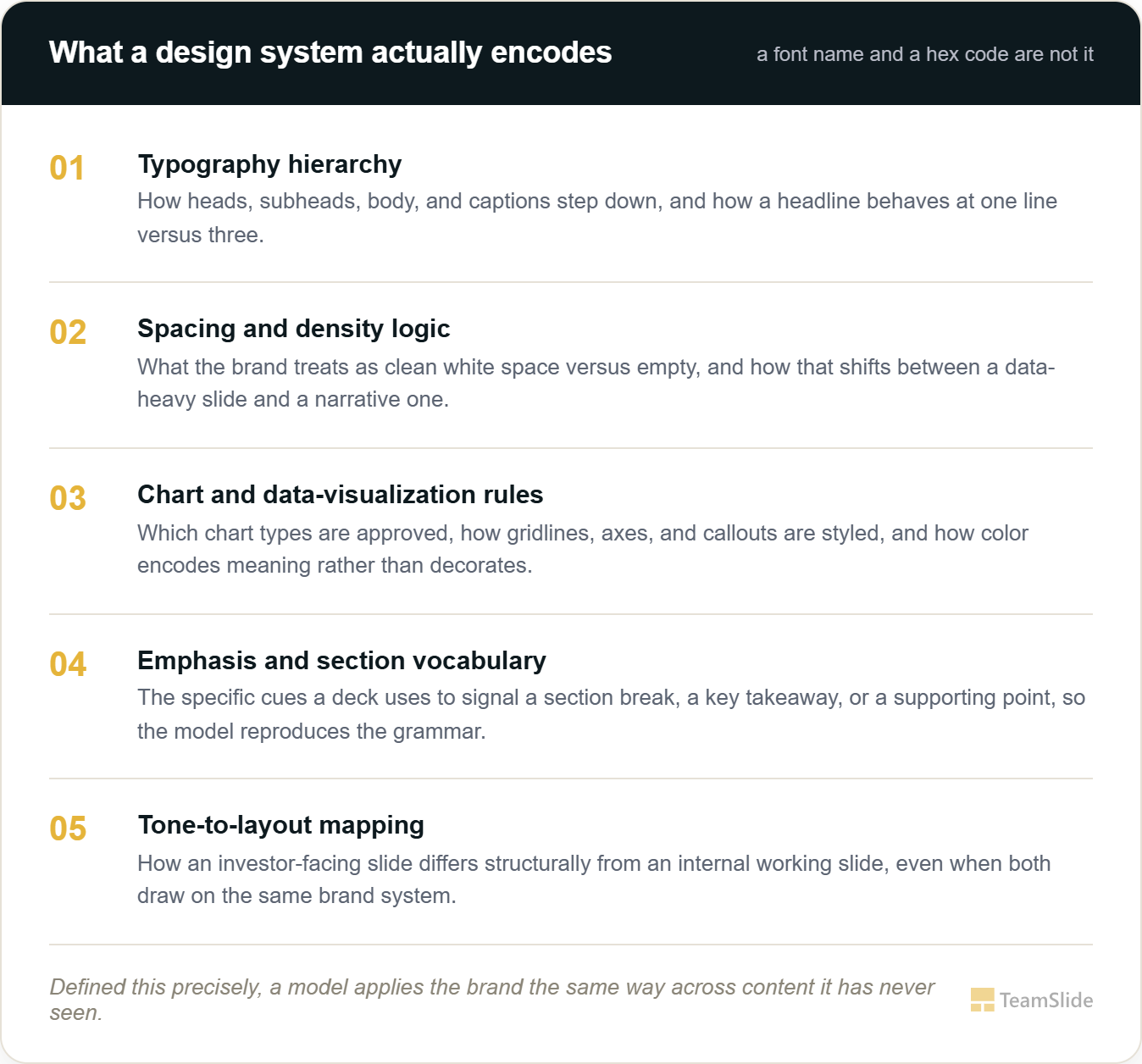
Most of this cannot be captured cleanly by a template library alone, and it becomes important when the goal is output that reads as enterprise-grade from the first draft.
What this actually changes
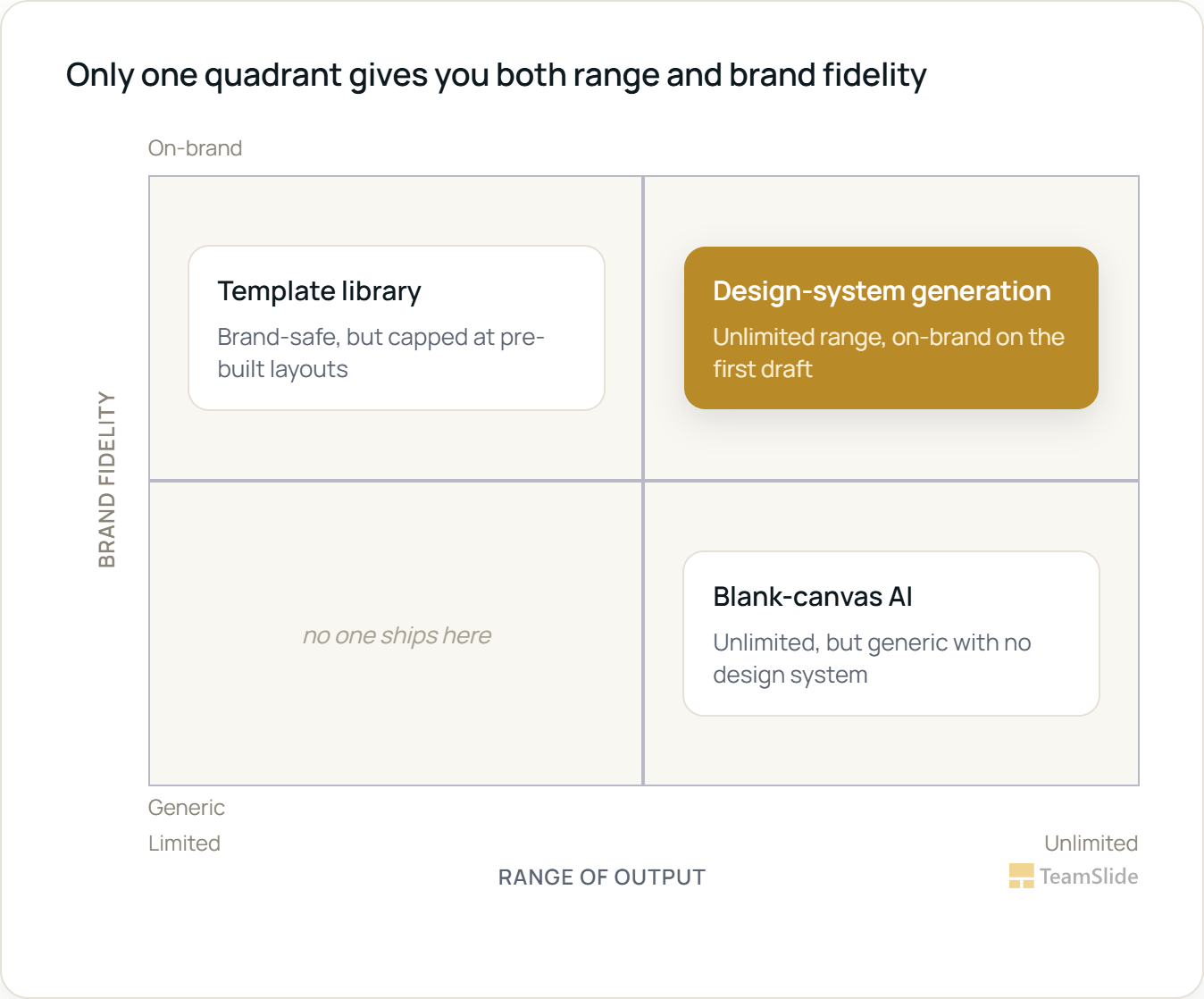
This is the layer Slidebuilder by TeamSlide is built to supply. Instead of choosing from a fixed set of templates, it can generate a much broader range of slides, each shaped by the client’s own design system rather than a generic pool or a model’s default taste. That is the top-right quadrant from earlier: broad range and brand fidelity at once, reducing the need to manually check and adjust each slide against the brand guide afterward.
For consulting, advisory, and other client-facing teams, that closes the distance between “AI-generated” and “client-ready.” The slide is not edited up to standard after it is generated; it is built to standard from the first draft. That is the difference between AI as a drafting shortcut and AI as a production tool, one that absorbs the hours now lost to manual deck-building instead of adding another editing pass on top.
On-brand output was never one good prompt away. It was one clear specification away.
Put it in front of your own brand
TeamSlide is opening early access to teams that want AI slide generation shaped by their own design system, not a generic one. If the gap between “AI-generated” and “client-ready” is one your team keeps running into, join the waitlist and we will get you in.
Frequently asked questions
What is a design system in AI slide generation?
A design system is the complete set of brand rules a model is given to follow when it builds slides from scratch. It covers typography hierarchy, color usage, spacing logic, chart styling, and the visual vocabulary that makes a slide recognizably on-brand, rather than letting the model fall back on its own generic instincts.
How is design-system-based generation different from template-based generation?
Template-based generation picks from a fixed, predefined library of layouts, so usable output is limited to what someone already built. Design-system-based generation lets the model build a new slide for any content while still following the brand’s explicit rules, so the range of usable output is effectively unlimited rather than capped by a template count.
Why does AI-generated slide content often look generic?
Without explicit brand rules to follow, a model defaults to the safe, average design choices it learned in training, which read as competent but interchangeable. In a 2026 Brafton survey, generic or thin-sounding output was the single most common concern among marketers using AI, cited more often than any other quality problem.
Does brand consistency in presentations actually affect revenue?
Research from Lucidpress and Marq has linked consistent presentation across customer touchpoints to revenue gains in the range of roughly 10% to 33%. The same trust-and-recognition mechanism applies to a client-facing deck: a consistently branded proposal signals reliability at the moment a firm is trying to win confidence.
Can AI slides be enterprise-ready without a manual brand review on every slide?
They can be, when the model is given a sufficiently complete design system upfront rather than loose styling notes. If the brand rules are defined explicitly enough to apply consistently, generated slides meet standard from the first draft, which removes the need to hand-edit each one up to spec afterward.
Is a design system the same as a brand style guide?
Not quite. A brand style guide is usually written for people and leaves a lot implicit, while a design system for AI generation makes those same rules explicit and machine-readable: how type scales across edge cases, how spacing shifts by slide type, how charts encode meaning. The style guide is the source; the design system is the version a model can apply consistently.