
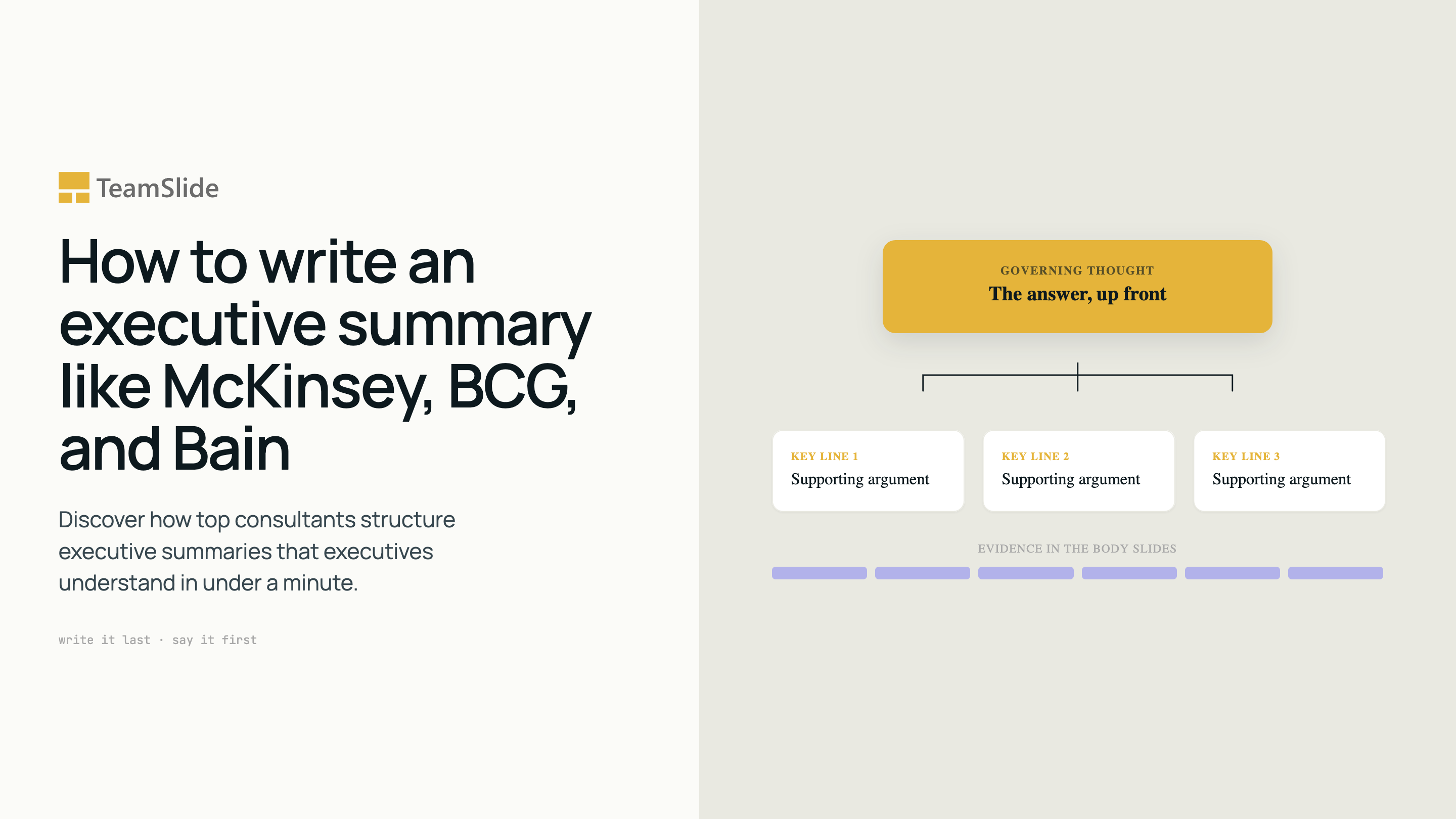

Early in a consulting career, a familiar lesson arrives fast: a forty-page deck comes back with a single instruction. Lead with the answer on page one, or don't present it. The analysis may be flawless, but if the recommendation is buried on slide 34, it may as well not exist. The executive summary is not the wrapper on the work; it is the work, compressed to the one page a chief executive will actually read on the walk to the meeting. Get it right and the rest of the deck becomes proof. Get it wrong and no amount of elegant analysis will rescue it.
The governing thought behind all of it fits in one line: write the executive summary last, but say it first. What follows is how the craft is practiced at McKinsey, BCG, and Bain, the logic beneath the polish, and a method any consultant can apply to the next deck tonight.
The summary is the map, not the recap
The reason the summary matters is structural. A well-built consulting deck can be read at three depths: the summary alone (thirty seconds), the section titles (two minutes), or the full body (twenty minutes). The summary is what lets a director flip through fifty pages in five and still leave with the argument intact. It supplies the context for why the topic deserves attention, states the recommendation before the reader wades into detail, and serves as a map to return to whenever the thread is lost.
Which is why it is written last. An argument that has not been finished cannot be summarized. Build the body, prove each claim, and only then distill the whole thing into the page that goes at the front.
It is an argument, not an abstract
The most common mistake, still seen from capable people at good firms, is to treat the summary as a table of contents in prose: “This deck covers the market, the competition, and three options.” That tells the reader what is coming; it does not tell them anything. An executive summary is an argument: a single claim, supported by a handful of reasons, each backed by evidence. Lead with the conclusion; justify it after.
This is the essence of the Pyramid Principle, developed by Barbara Minto during her years at McKinsey in the 1960s and since adopted as the house style across the profession. It inverts how most people are trained to think. Analysts build from the bottom up: facts, then analysis, then conclusion. Executives think from the top down. They want the destination first and the route second, if at all.
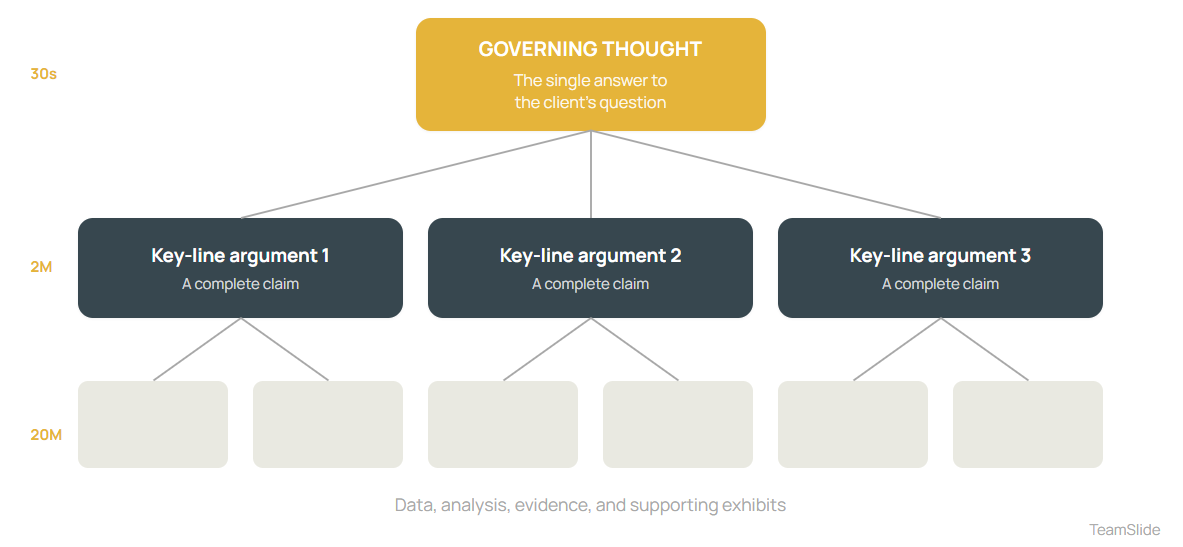
Note the discipline the pyramid imposes. The key-line arguments must be MECE: mutually exclusive, collectively exhaustive. No overlap between them, and together they must fully support the thought above. When three reasons do not add up to the conclusion, the reader feels the gap even without being able to name it.
Situation, complication, resolution
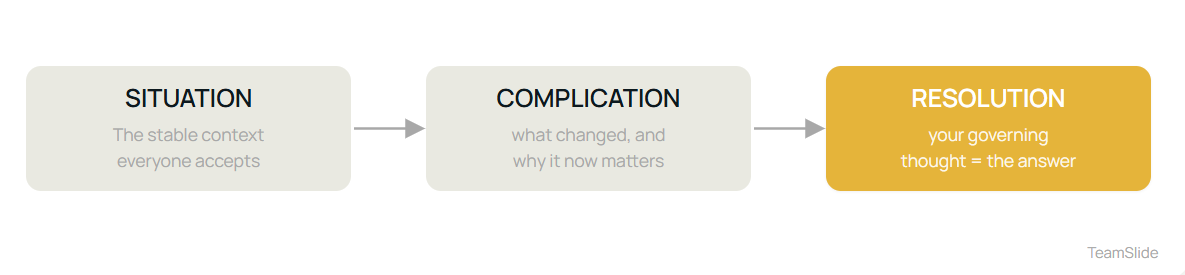
The pyramid explains what a summary argues. Before that argument lands, it needs an on-ramp. The opening lines follow a rhythm Minto named Situation–Complication–Resolution. Establish a stable, agreed context (the situation), introduce the thing that has changed or gone wrong (the complication), and answer the question that tension raises (the resolution, which is the governing thought at the top of the pyramid). It is the structure every good story uses, and it works because it lets the reader feel the problem before being handed the answer.
Deductive or inductive: choose on purpose
Once the opening has earned its way to the governing thought, one question remains: how are the key lines underneath it assembled? There are two ways, and strong summaries choose between them deliberately rather than by accident.
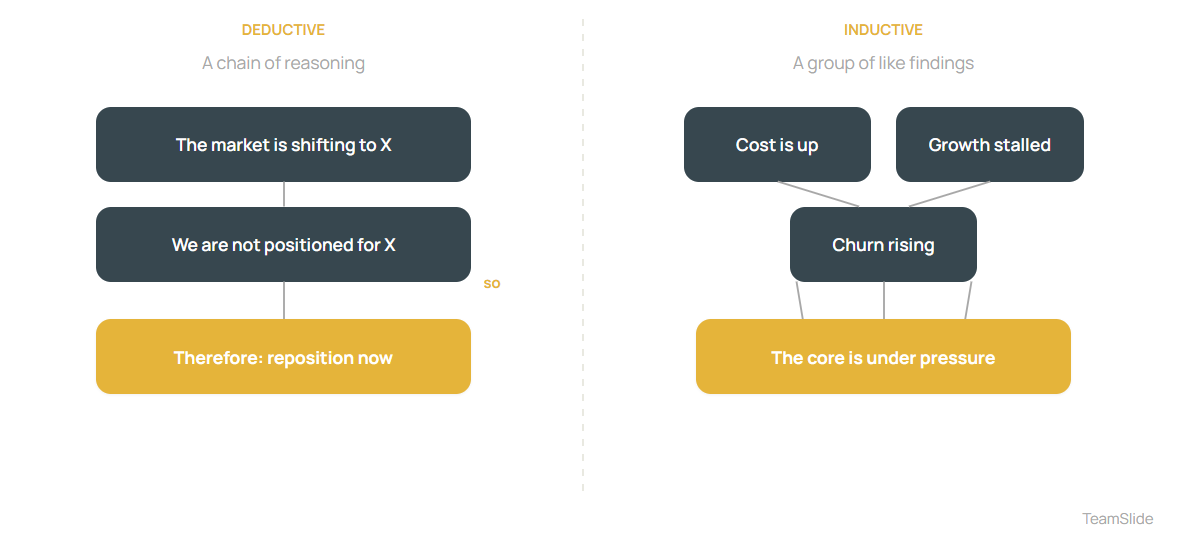
Deductive structure works when a resistant audience needs to be walked through the logic step by step, with no room left to disagree: the market is moving, the business is exposed, therefore it must act. Inductive structure works when several independent findings all point the same way, rising costs, stalling growth, climbing churn, and the aim is to group them under a single claim the reader can hold in mind. Most experienced consultants default to inductive at the summary level because it scans faster, and reserve deductive chains for the moments where the recommendation is genuinely contested.
McKinsey, BCG, and Bain: same spine, different accent
The structural spine is identical across the three firms. Where they differ is temperament, and knowing the differences helps a consultant borrow the right instincts.
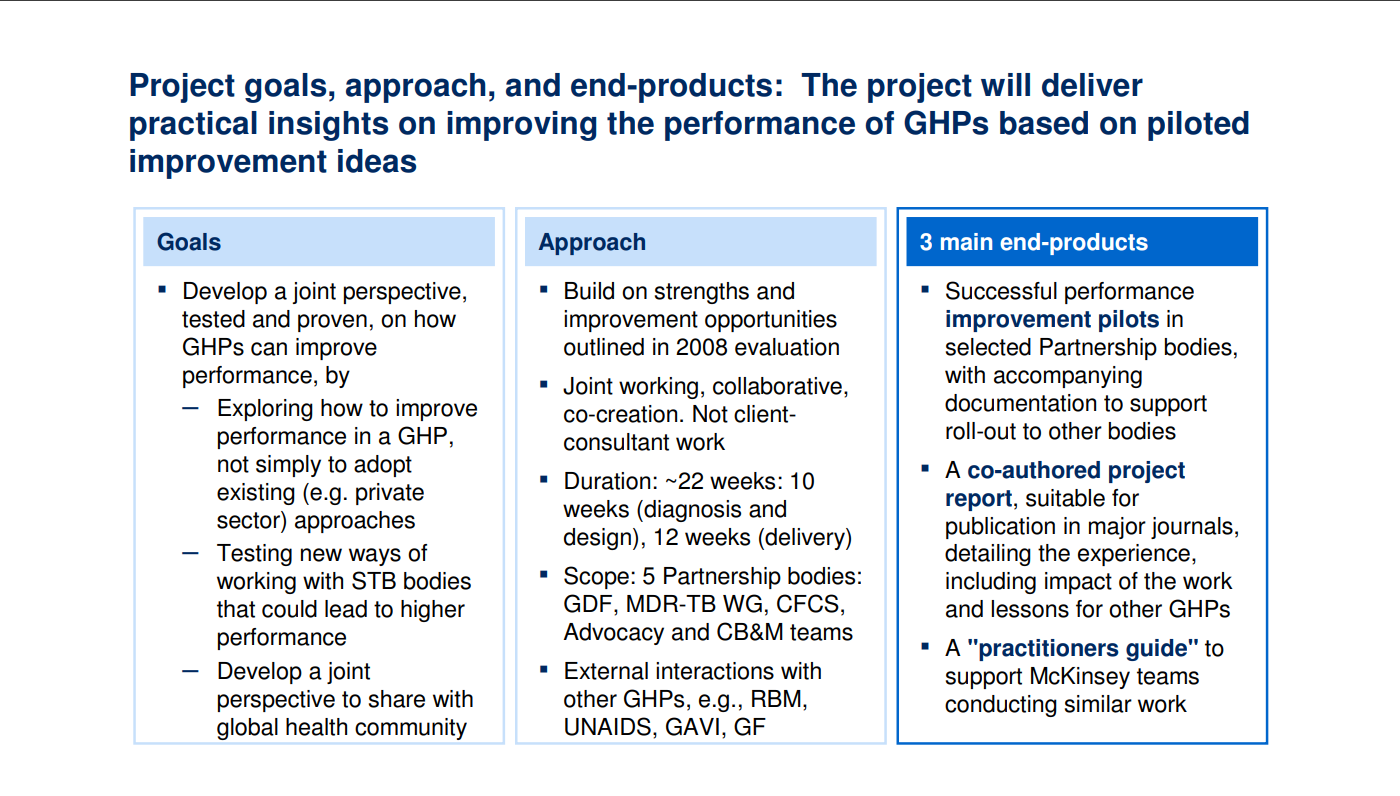
McKinsey is the most rigorously codified, unsurprising given Minto wrote the book there. Its summaries lead with a full-sentence action title: the governing message stated as a claim, not a topic label. Three to five supporting lines follow, each a complete finding or implication. A McKinsey summary line never begins “We analyzed…” or “Our research found…”; the reader does not care what the team did, only what is true. Many consultants use a simple rule of thumb: if a slide takes more than about a minute to explain, it is usually trying to do too much.
BCG leans hardest into visual clarity: the conviction that complexity is a design failure, not a badge of rigor. If a reader has to study a chart, the slide is wrong. BCG summaries are more visual and lean harder on named frameworks and the deliberate use of color to segment and compare, so a client can flip a forty-page deck in five minutes and reconstruct the whole argument.
Bain is the most action-oriented of the three, and it shows. Its summaries are the most prescriptive, weighted toward what the client should do rather than what the team found. If McKinsey leads with the answer and BCG leads with the picture, Bain leads with the move.
EXAMPLES WORTH STUDYING
Studying the craft does not require leaked internal decks; the firms publish their best thinking.
McKinsey Global Institute, Outperformers. Like most McKinsey publications, the report is built around a hypothesis-driven narrative rather than a standalone executive-summary slide. The argument unfolds through a sequence of diagnostics, evidence, and synthesized findings, with each page advancing a single message before culminating in clear recommendations. The emphasis is less on visual flourish and more on building an airtight logical case.
BCG, Executive Perspectives: AI and the Future of Software. Published April 2026, this short briefing is built entirely as a slide deck. Page two is labeled, in full, "Executive summary," and states the governing thought as a single bolded line, enterprise software incumbents can transform their P&L in light of AI, but must act now to win, before three supporting columns carry the why-now, how-to-start, and what-success-looks-like argument beneath it.

Bain, e-Conomy SEA 2025. Published annually with Google and Temasek, this is the rare Bain report actually built and delivered as a slide deck rather than a Word-style document. Its executive summary runs across two summary slides split into four labeled sections, growth momentum holding steady, investor interest cautiously returning, an intelligent economy advancing on AI, and a decade of transformation distilled into closing takeaways, each one a headline followed by three or four bulleted findings, never a description of method.

The contrast reflects each firm's communication style: McKinsey more often treats slides as evidence supporting a written narrative, while BCG and Bain, in these examples, let the executive-summary slide carry the argument on its own.
Description is not the same as direction
Most executive summaries do not fail because the analysis is weak. They fail because they stop one step too early. Instead of making an argument, they describe the work: the market studied, the analyses performed, the options considered. An executive does not need a preview of the deck. They need the recommendation the deck exists to prove.
The same pattern appears in other forms. Supporting points overlap instead of being MECE. Findings are presented without answering "so what?" The recommendation is buried halfway down the page, or the summary is written before the analysis has fully taken shape. Individually, these mistakes seem small. Together, they turn the most important slide in the deck into the easiest one to forget.
A useful test catches nearly all of them. Hide every slide except the first. If a client cannot explain what you recommend, why you recommend it, and what should happen next, the executive summary is not finished.
A prompt for drafting the summary
Once the body slides are built and the analysis is done, the structure above can be turned into a first draft quickly. The prompt below forces the pyramid discipline rather than producing a topic list: feed it the findings and refine from there.
COPY · EXECUTIVE SUMMARY PROMPT
Role: You are a senior strategy consultant writing the executive-summary slide of a client deck. You follow the Pyramid Principle.
Before writing, ask one question if it isn't already answered: what single client question must this deck answer?
Then, from the findings provided, produce:
1. A 2–3 sentence opener in Situation–Complication– Resolution form.
2. ONE governing thought, written as an action title, a full-sentence claim that IS the answer, not a topic (e.g. “Reposition to mid-market now,” not “Positioning”).
3. 3–5 key-line arguments that are MECE. Each is a complete claim, not a data label.
4. Under each, the 1–2 strongest proof points from the findings.
Constraints:
– No line may begin “We analyzed…” or “Our research found…”; findings and implications only.
– Every line must pass the “so what?” test.
– State whether the arguments are deductive or inductive, and why.
Findings: [paste your body-slide takeaways here]
The one question a partner asks
Reviewing a summary comes down to a single test, run on every line including the title: so what? A line that survives the question, one that already carries its own implication, stays. A line that meets silence is description masquerading as insight, and it goes. “Revenue grew 4%” invites the question. “Growth has stalled below the rate needed to fund the turnaround” answers it. Run it at all three depths from the start of this piece, the thirty-second version, the two-minute version, the twenty-minute version, and a good summary survives at every one.
A governing thought is doing its job when a client can repeat it, correctly, three weeks after the meeting, without the deck in front of them.
Turn your analysis into a partner-grade summary slide
The thinking is done. TeamSlide's AI slide generator builds the executive summary, governing thought, MECE key lines, and clean supporting exhibits, straight into PowerPoint, so independent consultants can ship boardroom-ready decks without a design team.
→ Join the waitlist for early access
FAQs
What is an executive summary in a consulting deck?
An executive summary is the opening slide of a consulting deck that states the full argument and recommendation in one page, before any supporting detail. It follows the Pyramid Principle: a single governing thought, backed by three to five key-line arguments, each supported by evidence in the body slides. It is written last, after the analysis is complete, but placed first so a busy executive can grasp the conclusion in under a minute.
What is the Pyramid Principle?
The Pyramid Principle is a communication framework developed by Barbara Minto at McKinsey in the 1960s, which structures an argument as a single top-level conclusion supported by grouped, evidence-backed reasons underneath. It reverses how most people naturally think, bottom-up, from facts to conclusion, into a top-down structure built for executives who want the answer first.
What does MECE mean in consulting?
MECE stands for Mutually Exclusive, Collectively Exhaustive. It is the test applied to the key-line arguments under a governing thought: each argument must cover distinct ground with no overlap, and together they must fully support the conclusion above them. If the arguments are not MECE, the reader senses a gap in the logic even without being able to name it.
What is the Situation-Complication-Resolution framework?
Situation-Complication-Resolution (SCR) is the opening structure used to introduce an executive summary: state the stable, agreed context (situation), introduce what has changed or gone wrong (complication), then answer the tension with the governing thought (resolution). It is typically two to three sentences, meant to earn the reader's attention before the argument itself begins.
Do you write the executive summary before or after the rest of the deck?
The executive summary is written last, even though it appears first in the deck. It summarizes an argument that has to already exist, so the body slides, analysis, and evidence are built first, and the summary is distilled from the finished work.
What is the difference between how McKinsey, BCG, and Bain build executive summaries?
All three firms use the same Pyramid Principle structure, but with different emphasis. McKinsey leads with a full-sentence action title and is the most rigorously text-driven; BCG leans on visual clarity and named frameworks so a chart can be understood in seconds; Bain is the most prescriptive of the three, weighting the summary toward what the client should do rather than what was found.
Should an executive summary use deductive or inductive reasoning?
Use deductive reasoning, a single chain of premise, premise, therefore, when walking a skeptical audience through logic that must hold at every step. Use inductive reasoning, grouping several parallel findings under one claim, when multiple independent observations already point the same way; it is faster to scan and is the more common default for summary slides.
Can AI write an executive summary for a consulting deck?
AI tools can draft a strong first pass of an executive summary if given a clear prompt that enforces the Pyramid Principle: a defined client question, a governing thought stated as a claim rather than a topic, MECE key-line arguments, and a ban on process language like “we analyzed.” The output still needs a partner's edit, the model can assemble the structure, but the judgment about which finding actually deserves the apex of the pyramid is still the consultant's call.